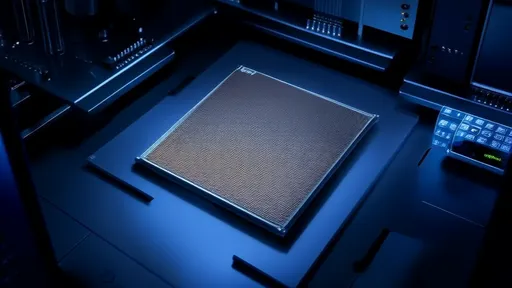
In a groundbreaking development for optoelectronic technologies, researchers have unveiled a novel infrared photodetector based on antimonene quantum dots operating at room temperature. This innovation promises to revolutionize applications ranging from night vision to medical imaging by combining the unique properties of two-dimensional materials with the quantum confinement effects of nanoscale structures.
The core of this advancement lies in the exceptional electronic properties of antimonene, a single-layer allotrope of antimony that has recently joined the family of two-dimensional materials. Unlike its more famous cousin graphene, antimonene possesses a sizeable bandgap that makes it particularly suitable for optoelectronic applications. When fashioned into quantum dots, these antimonene structures exhibit remarkable light absorption characteristics across the infrared spectrum.
What sets this new detector apart is its unprecedented performance at ambient conditions. Traditional infrared detectors, especially those operating in the mid- to long-wave infrared ranges, typically require cryogenic cooling to reduce thermal noise. The antimonene quantum dot device maintains high sensitivity and fast response times without the need for complex cooling systems, dramatically reducing both cost and energy consumption while enabling more compact device architectures.
The research team achieved this breakthrough through precise control of quantum dot size and surface chemistry. By tuning the diameter of the antimonene quantum dots between 3-5 nanometers, they optimized the bandgap for specific infrared wavelengths. Surface passivation with organic ligands further enhanced the stability and quantum efficiency of the dots, preventing oxidation while maintaining excellent charge transport properties.
Practical applications for this technology span multiple industries. In security and defense, it could lead to lighter, more affordable night vision goggles and surveillance systems. Medical diagnostics might benefit from improved infrared imaging for cancer detection or blood glucose monitoring. The automotive sector could integrate these detectors into advanced driver-assistance systems for better object recognition in all weather conditions.
From a manufacturing perspective, the solution-processable nature of antimonene quantum dots offers significant advantages. The dots can be synthesized through relatively simple colloidal chemistry methods and deposited onto various substrates using inkjet printing or spin-coating techniques. This compatibility with scalable production methods suggests a clear path from laboratory breakthrough to commercial implementation.
The detector's performance metrics are particularly impressive. Early prototypes demonstrate detectivity values exceeding 10^11 Jones at room temperature, with response times in the nanosecond range. These figures rival or surpass those of cooled semiconductor detectors while operating under much less stringent environmental requirements. The broadband response, covering wavelengths from 1.5 to 5 micrometers, makes the device versatile for numerous applications.
Challenges remain before widespread adoption can occur. Researchers are working to further improve the uniformity of quantum dot sizes and develop more robust device packaging. Long-term stability under various environmental conditions also requires additional investigation. Nevertheless, the progress represents a significant step toward practical quantum dot optoelectronics operating beyond the visible spectrum.
This development also opens new avenues for fundamental research. Scientists are particularly interested in studying the quantum confinement effects in antimonene structures and how they differ from more conventional semiconductor quantum dots. The strong spin-orbit coupling in antimonene suggests potential for spin-based quantum technologies that could extend beyond photodetection applications.
As the field of two-dimensional materials continues to mature, antimonene is emerging as a strong contender for next-generation optoelectronic devices. Its combination of air stability, tunable bandgap, and now demonstrated utility in quantum dot form positions it as a versatile material for future technologies. The successful demonstration of room-temperature infrared detection marks just the beginning of what may become a transformative technology across multiple sectors.
The research team is currently collaborating with industrial partners to scale up production and integrate the detectors into prototype systems. While commercial availability may still be several years away, the potential impact on infrared sensing technology is undeniable. As development continues, we may soon see antimonene quantum dot detectors enabling new capabilities in fields as diverse as astronomy, environmental monitoring, and consumer electronics.

By /Aug 5, 2025
By /Aug 5, 2025

By /Aug 5, 2025

By /Aug 5, 2025

By /Aug 5, 2025

By /Aug 5, 2025

By /Aug 5, 2025

By /Aug 5, 2025

By /Aug 5, 2025

By /Aug 5, 2025

By /Aug 5, 2025

By /Aug 5, 2025

By /Aug 5, 2025

By /Aug 5, 2025

By /Aug 5, 2025

By /Aug 5, 2025

By /Aug 5, 2025

By /Aug 5, 2025

By /Aug 5, 2025

By /Aug 5, 2025